

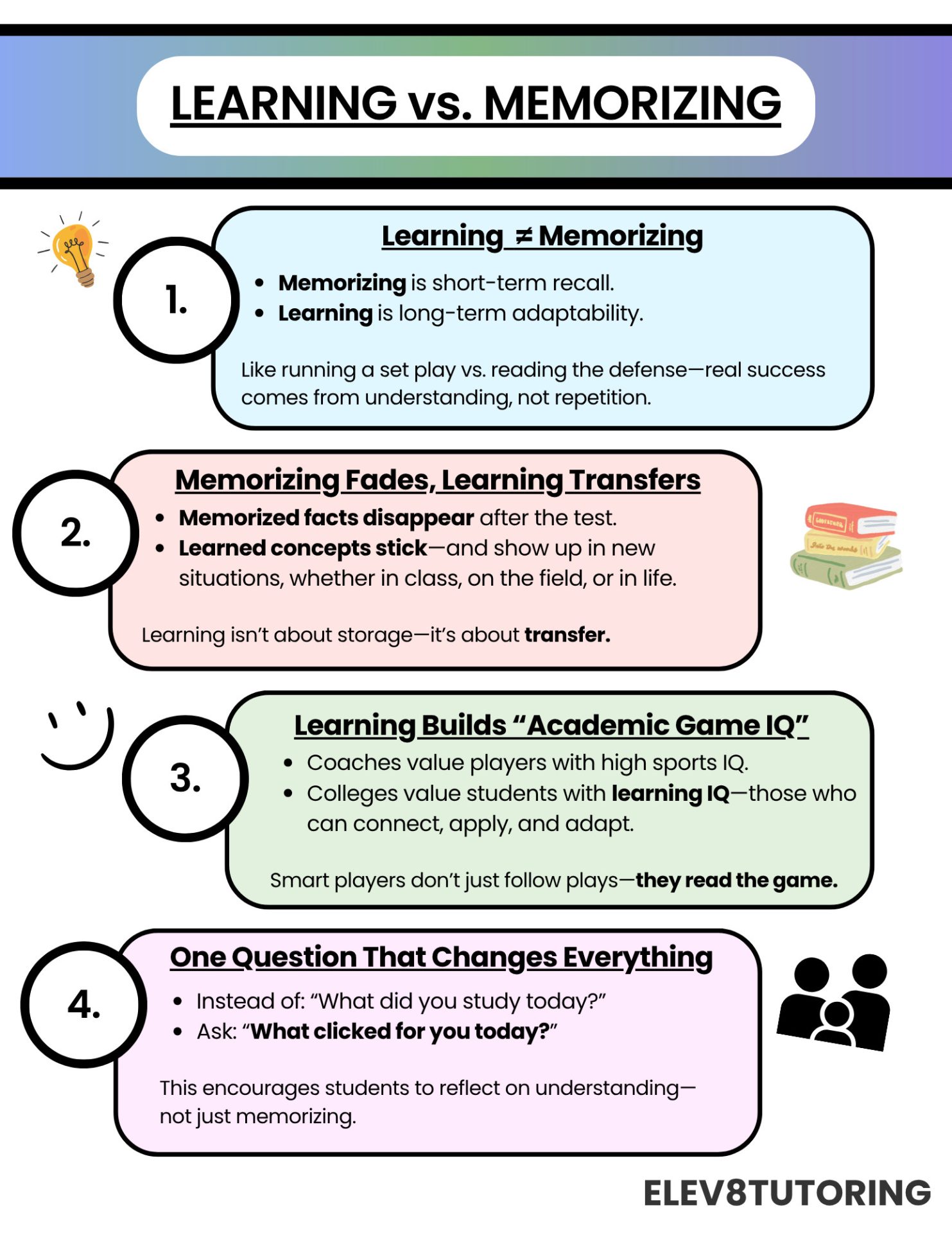
Learning vs. Memorizing
What’s the Difference?
One of the most important lessons a student-athlete can learn is the difference between memorizing and understanding—and why that distinction matters both in the classroom and on the field.
Memorizing is the act of storing and recalling information through repetition. It’s useful for quickly accessing facts, definitions, or steps—especially when preparing for tests or completing tasks that require accuracy.
Learning is about developing a deeper understanding of ideas. It involves connecting new concepts to existing knowledge and applying them in different situations. Learning encourages critical thinking and builds long-term comprehension.
For student-athletes juggling busy schedules and high expectations, this distinction can shape how they succeed in and out of the classroom.
Pros and Cons: Memorization and Learning
|
Pros ✅ |
Cons ❌ |
|
| Memorization | – Fast and efficient
– Helpful for tests and quizzes – Good for recalling facts and formulas |
– Short-term retention
– Often lacks depth – Hard to apply in new situations |
| Learning | – Builds lasting understanding
– Encourages critical thinking – Applies across contexts |
– Takes more time and effort
– Slower for quick prep – Can involve confusion |
Learning Mirrors the Demands of Sport
This mindset is especially important for student-athletes. In sports, things rarely go exactly as planned. Plays break down. Conditions shift. You have to think on your feet. The athletes who thrive are the ones who understand the game well enough to pivot and problem-solve in the moment. Learning works the same way. It prepares students to handle the unexpected, to transfer knowledge, and to keep building on what they know.
Understanding Is the Strongest Foundation
When a student truly understands a concept, they’re not just prepared for the next test—they’re building something lasting. That kind of understanding supports future classes, helps them adapt when things get tough, and gives them the tools to think independently. It’s a skill set that goes far beyond school. It lays the groundwork for thoughtful, capable, and confident young adults.
What We Do Differently at Elev8
At Elev8, our tutoring is centered on this deeper kind of learning. We slow things down when needed, help students connect the dots, and encourage them to get curious. We’re not just focused on boosting scores—we’re helping students become clearer thinkers, better problem-solvers, and more engaged learners. And because we know student-athletes have unique demands on their time and energy, we tailor our sessions to make the most of every minute.
How Families Can Support Deep Learning
Sometimes, the biggest shift starts at home. Instead of asking, “Did you get your homework done?”, try asking, “What clicked for you today?” That simple change encourages reflection, and helps your student focus on understanding—not just finishing the task.
A Mindset That Lasts Beyond the Season
Deep learning creates lasting impact. It prepares students not just for the next assignment, but for the challenges and opportunities that come after it. For student-athletes, that kind of mindset—one built on understanding, not just repetition—can be one of the most important forms of training they’ll ever do.